




First-time home buyers glossary
Print the buyer terms
The terms you'll hear from offer to closing.
Resources
Buying, selling, or building a home comes with a lot of new words. Here are the ones you're most likely to hear, in plain English.
Rob and Samantha
Hey! You don’t need to know them all. That’s what we’re here for. Reach out with any questions.
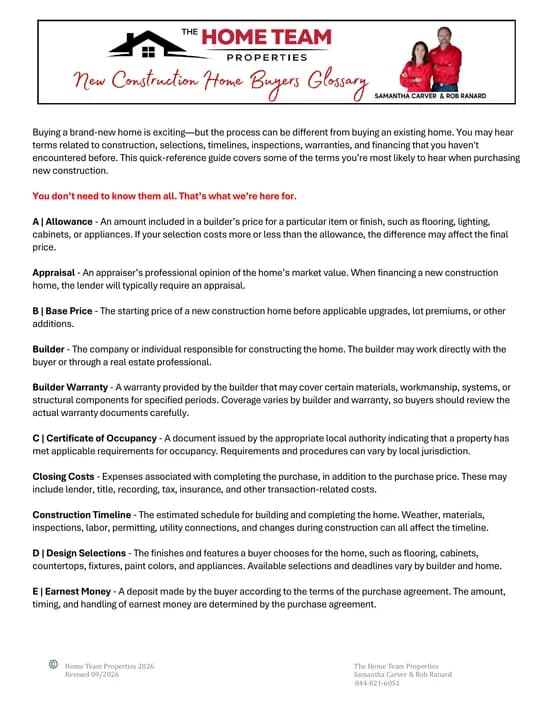
An amount included in a builder’s price for a particular item or finish, such as flooring, lighting, cabinets, or appliances. If your selection costs more or less than the allowance, the difference may affect the final price.
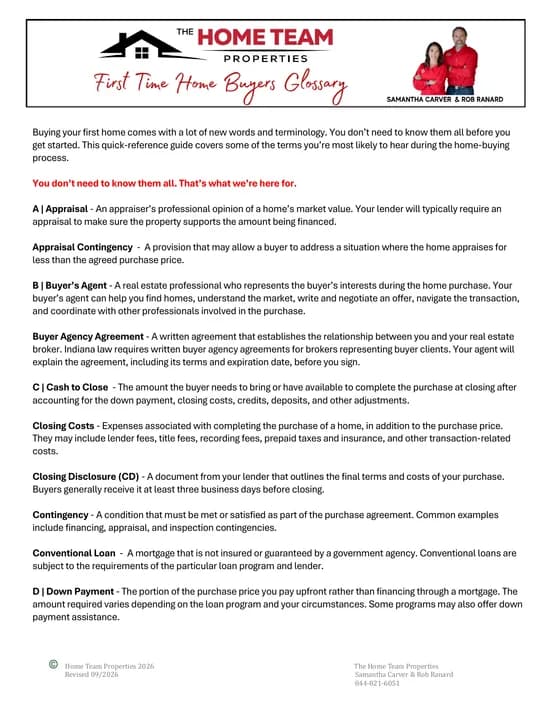
An appraiser’s professional opinion of a home’s market value. Your lender will typically require an appraisal to make sure the property supports the amount being financed.
A provision that may allow a buyer to address a situation where the home appraises for less than the agreed purchase price.
The starting price of a new construction home before applicable upgrades, lot premiums, or other additions.
The company or individual responsible for constructing the home. The builder may work directly with the buyer or through a real estate professional.
A builder may provide a walk-through before closing to explain the home's systems, features, maintenance requirements, and operation. This is a good opportunity to ask questions and learn how everything works.
A warranty provided by the builder that may cover certain materials, workmanship, systems, or structural components for specified periods. Coverage varies by builder and warranty, so buyers should review the actual warranty documents carefully.
A written agreement that establishes the relationship between you and your real estate broker. Indiana law requires written buyer agency agreements for brokers representing buyer clients. Your agent will explain the agreement, including its terms and expiration date, before you sign.
A real estate professional who represents the buyer’s interests during the home purchase. Your buyer’s agent can help you find homes, understand the market, write and negotiate an offer, navigate the transaction, and coordinate with other professionals involved in the purchase.
The amount the buyer needs to bring or have available to complete the purchase at closing after accounting for the down payment, closing costs, credits, deposits, and other adjustments.
A document issued by the appropriate local authority indicating that a property has met applicable requirements for occupancy. Requirements and procedures can vary by local jurisdiction.
Expenses associated with completing the purchase of a home, in addition to the purchase price. They may include lender fees, title fees, recording fees, prepaid taxes and insurance, and other transaction-related costs.
A document from your lender that outlines the final terms and costs of your purchase. Buyers generally receive it at least three business days before closing.
The estimated schedule for building and completing the home. Weather, materials, inspections, labor, permitting, utility connections, and changes during construction can all affect the timeline.
A condition that must be met or satisfied as part of the purchase agreement. Common examples include financing, appraisal, and inspection contingencies.
A mortgage that is not insured or guaranteed by a government agency. Conventional loans are subject to the requirements of the particular loan program and lender.
The finishes and features a buyer chooses for the home, such as flooring, cabinets, countertops, fixtures, paint colors, and appliances. Available selections and deadlines vary by builder and home.
The portion of the purchase price you pay upfront rather than financing through a mortgage. The amount required varies depending on the loan program and your circumstances. Some programs may also offer down payment assistance.
A deposit submitted with an offer to show the seller that you are serious about purchasing the home. The purchase agreement determines how the deposit is handled and, if the transaction closes, it is typically applied toward the buyer’s purchase costs.
A mortgage insured by the Federal Housing Administration that may offer qualifying buyers options for a lower down payment.
A final visit to the property shortly before closing. The buyer typically uses this opportunity to make sure the property is in the expected condition and that agreed-upon items remain with the home.
Buyers can use this time to confirm that the home is in the expected condition and that agreed-upon items and improvements have been completed.
A mortgage with an interest rate that remains the same for the life of the loan. A fixed-rate mortgage can be available with several types of loan programs.
An organization that establishes and enforces rules and may maintain common areas and amenities within a community. New developments may have HOA fees, covenants, or other restrictions.
An Indiana property-tax deduction available to qualifying homeowners who use a property as their principal residence. It can reduce the assessed value used to calculate property taxes.
An examination of the home’s condition by a qualified home inspector. An inspection can help identify potential concerns with the home’s structure, systems, and components. Buyers may also choose additional inspections or testing, such as radon, septic, well, or termite inspections.
Even though a home is new, buyers may choose to have an independent inspection performed.
A document provided by your lender after you apply for a mortgage. It gives you an estimate of your loan terms, monthly payment, and closing costs.
The parcel of land on which the home is located. Lot size, location, orientation, drainage, utilities, easements, and restrictions can all affect a new construction purchase.
A completed home used to showcase a builder’s floor plan, finishes, features, and design options. Some features shown in a model may be upgrades rather than standard features.
The point at which the buyer is entitled to take possession of the completed home. This is generally addressed in the purchase agreement.
A lender’s preliminary determination of how much you may be able to borrow based on information such as your income, assets, debts, and credit. A pre-approval can help you understand your price range before you begin making offers.
An early estimate of how much you may be able to borrow, generally based on information you provide to a lender. A pre-qualification is typically less comprehensive than a pre-approval.
Mortgage insurance that may be required with certain conventional loans when the buyer has a smaller down payment. PMI protects the lender—not the buyer—against potential loss if the borrower does not repay the loan.
An adjustment made at closing to account for property taxes that apply to the period when the property was owned by the seller versus the buyer.
A list of items that need to be completed, corrected, adjusted, or addressed before or after the home is finished.
The contract between the buyer and seller that outlines the terms and conditions of the home purchase. Once accepted and properly executed, it establishes the obligations of both parties.
A resale home has previously been owned and occupied, while new construction is newly built and being sold for the first time. The buying process, available selections, inspections, timelines, and warranties can differ.
Costs or expenses the seller agrees to pay on behalf of the buyer, when permitted by the loan program and purchase agreement. These may help a buyer with certain allowable closing costs or prepaid expenses.
The real estate professional who represents the seller in the transaction. The seller’s agent works on the seller’s behalf, including marketing the property and negotiating the terms of a sale.
A home a builder constructs based on predetermined plans, features, and finishes rather than building every detail specifically for an individual buyer. A spec home may be completed or under construction when purchased.
The features and finishes included in the builder’s advertised or base price. It's important to understand what is included—and what may be considered an upgrade—before comparing homes or builders.
Coverage that may apply to certain major structural components of a new home for a specified period. The exact coverage depends on the builder and applicable warranty.
The legal right to ownership of a property. Before closing, a title search is generally completed to identify ownership history, liens, easements, or other matters that may affect the property.
Insurance that can protect against certain covered title-related problems that existed before the policy was issued. Your lender may require lender’s title insurance, while owner’s title insurance may be available to protect the buyer’s ownership interest.
A feature, material, finish, or design option that is not included in the home's standard specifications and may increase the purchase price.
A government-backed mortgage program that may be available to qualifying buyers purchasing eligible properties in designated areas.
A mortgage program available to eligible veterans, service members, and certain surviving spouses, subject to program requirements.
The process of reporting and addressing covered issues after the home is completed. Builders typically have a process for submitting warranty requests, and buyers should understand how and when to submit them.
Print a copy
The terms come from our two printable glossaries. Both are free to download.
First-time home buyers glossary
The terms you'll hear from offer to closing.
New construction glossary
Lot premiums, spec homes, upgrades, and builder warranties.
Ask the HOME TEAM
There will probably be terms, documents, and questions that aren't covered on this page. That’s okay. Ask us.

Prefer to talk it through first? Give us a call and you'll reach Samantha or Rob directly.
Tell us what you're wondering about and we'll get you an answer.